

Agentic AI is the most exciting technology trend of 2026.
But despite offering the most significant transformational opportunity since the dawn of the internet, most companies I talk to don’t have a clear roadmap. And honestly, it can be confusing to connect the dots between all of the AI models, frameworks, and guidance available. So I compiled industry data and case studies on how companies are adopting AI as they mature, looking for a repeatable framework to evolve from testing to leadership.
9 hours later, here’s what I learned:
Quick Stats About the Gap between AI Leaders and Laggards
BCG completed a study on “The Widening AI Value Gap,” and what separates AI leaders from laggards. Here are some interesting stats from their research:
Only 5% of organizations qualified as “Future-built” for AI (1).
1.7x Revenue Growth: AI leaders are currently generating nearly double the revenue growth of their slower-moving competitors (1).
1.6x Higher EBIT Margins: Mature organizations aren’t just growing faster; they are significantly more profitable because they’ve moved from “chatting” with AI to automating core business logic (1).
40% Greater Cost Reductions: By utilizing agentic systems that autonomously solve multi-step problems, leaders are achieving nearly double the operational savings of those still in the “experimentation” phase (1).
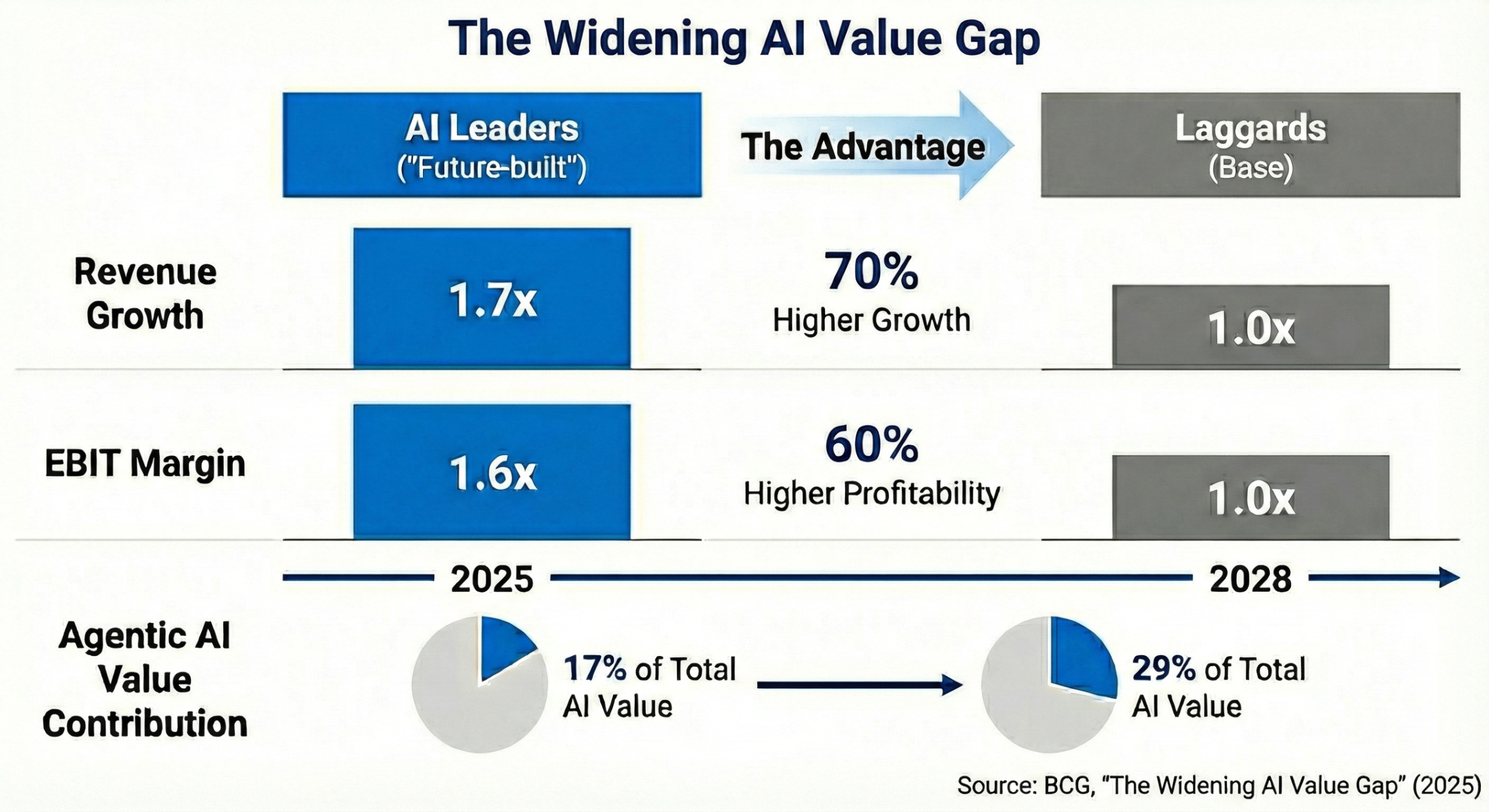
BCG’s research also shows that AI leaders follow a consistent playbook with five core strategies. Paraphrasing from their report, these organizations tend to (1):
Set an aggressive, multiyear AI vision with direct sponsorship from executive leadership
Prioritize AI initiatives based on business value and rigorously track results
Shift to an AI-first operating model built around human-machine collaboration
Invest heavily in talent—anticipating new skill requirements, leveraging their partner ecosystem, and upskilling at scale
Build a modular, fit-for-purpose technology architecture on a solid data foundation
This is great... but if you’re just starting (or even if you’re already down the path), how do you get from where you are today to “future-built?”
A Strategic Maturity Model for AI Adoption
From my research and my own experience, companies adopting AI tend to move through four stages:
Stage 1: Exploration, Initial Literacy, and Proof-of-Concept
Stage 2: Launching Production-Ready Point Solutions
Stage 3: Systemic Integration into External & Internal Products and Processes
Stage 4: AI First — AI Assisted by Humans
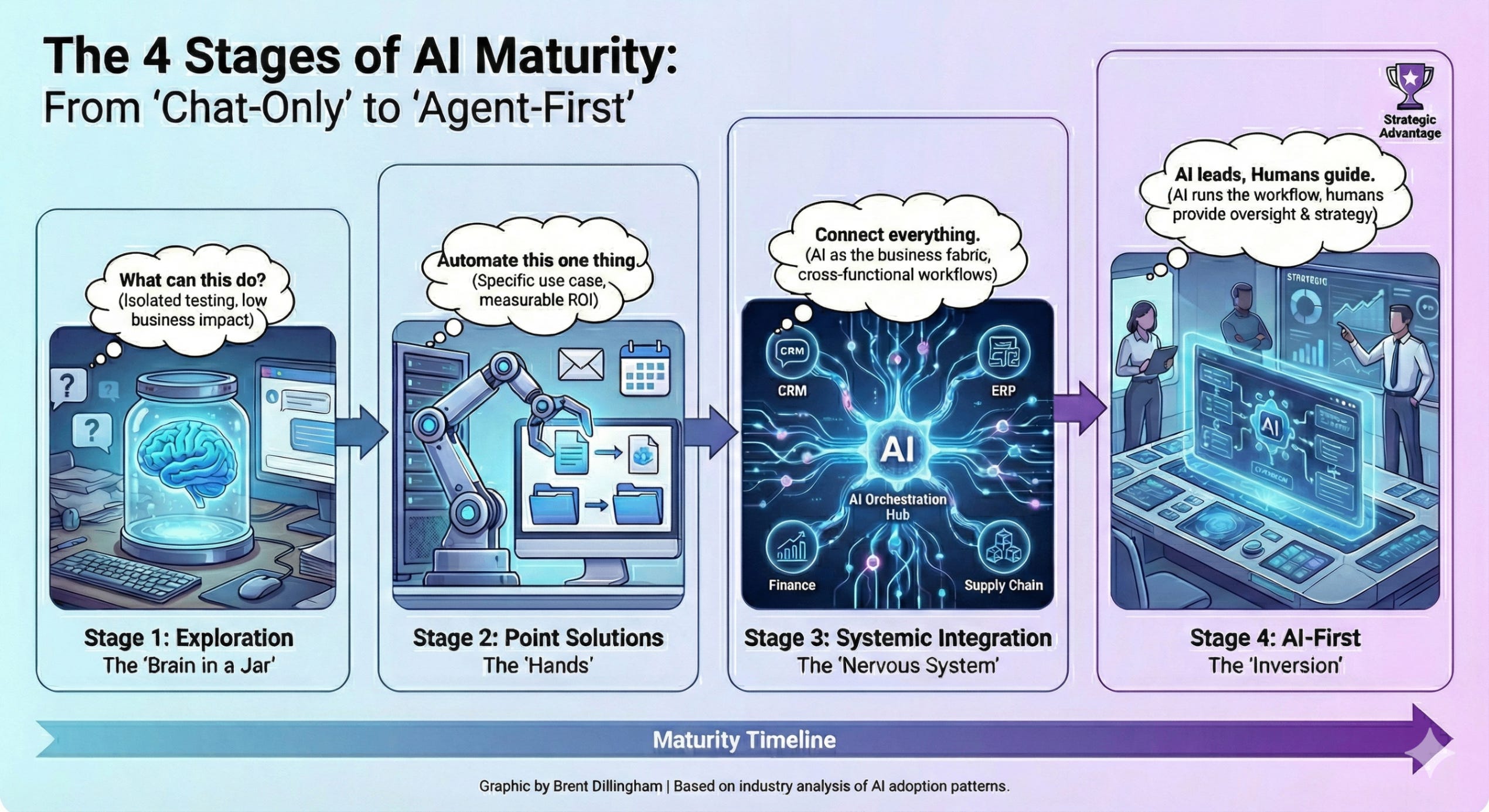
Let’s dive deeper into what each of these stages entails.
Stage 1: Exploration, Initial Literacy, and Proof-of-Concept
This is where most conversations I have start. The company knows AI matters, but nobody’s quite sure who owns it yet. Someone on the team is already using ChatGPT or Claude on the side (what the industry calls “Shadow AI”), and leadership is somewhere between excited and nervous.
According to MIT CISR’s Enterprise AI Maturity Model, roughly 28% of enterprises are in this early stage of experimenting and preparing (2). The goal isn’t revenue impact yet—it’s proving that a meaningful use case actually works. That means running a structured Proof-of-Concept with clearly defined success criteria. What KPIs will tell you this worked? What does “failure” look like? Organizations that skip this step often end up with something that technically works but nobody can explain the value of.
This is also where you demystify AI for the board—get everyone speaking the same language about risk, ethics, and where the value actually lives.
The trap here is “Pilot Purgatory”—running demos that never graduate to production because there’s no scalable infrastructure or business case behind them. More critically, Shadow AI is a real risk: employees feeding proprietary data into consumer tools without any guardrails is more common than most leaders realize.
Stage 2: Launching Production-Ready Point Solutions
Stage 2 is where you go from experimenting to building something real.
The focus shifts to deploying AI solutions that solve specific, high-value problems—and proving it with financial KPIs. MIT CISR found about 34% of organizations are in this stage of building pilots and developing capabilities (2), and this is when you start seeing measurable business outcomes for the first time.
The technology requirements change, too. You’re not building a demo anymore—you need security, reliability, and integration with the systems your business already runs on.
Take Bynder, a digital asset management company serving over 4,000 customers. They built an AI-powered visual search—one well-scoped production use case with clear KPIs. The result: a 75% reduction in asset search time and approximately 50% more accurate results (6).
The biggest risk I see at this stage is fragmentation. Different departments spin up their own AI solutions that don’t talk to each other, don’t share data, and don’t follow common standards. You’ve essentially built new silos—which is exactly what you’re trying to eliminate. You also need observability tooling to catch model drift before performance quietly degrades in production.
Stage 3: Systemic Integration into External & Internal Products and Processes
This is where AI stops being a “tool” and starts becoming the nervous system of the business.
It’s also where the gap between leaders and laggards really opens up. The companies at this stage aren’t just using AI in a few places—they’ve woven it into how they build products, serve customers, and run operations. Gartner predicts that at least 15% of day-to-day work decisions will be made autonomously by AI agents by 2028, up from essentially 0% in 2024 (4). And research from the St. Louis Fed shows workers are already 33% more productive during the hours they use Generative AI (5).
A strong example of what this looks like in practice is OPLOG, a technology-driven fulfillment company that built an AI agent orchestration system on AWS—not a single AI, but an intelligent network of specialized agents designed to handle specific operational domains while coordinating with each other. OPLOG achieved a 90% reduction in decision-making time and an 8% increase in customer satisfaction. Their 2030 vision: 90% of decisions made autonomously by AI (7). That’s AI as a nervous system, not a tool.
Getting here requires three shifts that I think are underappreciated:
Business and IT co-own outcomes. IT isn’t just a service provider anymore—business leaders and tech teams share accountability for what AI delivers.
Redesign, don’t layer. Companies at this stage stop bolting AI onto old workflows and start redesigning entire value chains—R&D, manufacturing, sales, marketing—to be AI-native.
Massive upskilling. We’re talking 50%+ of the workforce trained to collaborate effectively with AI systems (1). That’s not a lunch-and-learn—it’s a strategic investment.
The risk here is technical debt. Without a modern, agent-ready data architecture, data stays trapped in formats and systems that limit what AI can actually do.
Stage 4: AI First — AI Assisted by Humans
This is the inversion. Instead of humans using AI as a tool, AI runs the workflow and humans provide strategic oversight and handle exceptions.
Consider Anker Innovations, the global smart hardware company. They’ve built more than 300 active AI agents that help generate over 50% of their code and resolve 70% of support tickets (8). That’s not a pilot—that’s an operating model.
At this stage, the conversation shifts from “how do we use AI?” to “how do we manage the relationship between AI agents and the people overseeing them?” In most workstreams, the human role becomes validation—checking the highest-stakes outputs rather than doing the underlying work.
The risks here are about control: robust observability into what agents are actually doing, least-privileged access so no single agent has more authority than it needs, and strong identity controls across the whole network. Without those guardrails, autonomy becomes a liability.
Economic Benchmarking and the ROI of AI Maturity
As outlined earlier, the financial incentive for progressing through these maturity stages is significant. BCG’s research shows that “Future-built” organizations outpace their peers in revenue growth and gross margin. The performance gap isn’t just wide—it’s widening, with leaders planning to spend more than twice as much on AI compared to laggards in 2025, further compounding their advantage (1).
Final Recommendations for Leadership
To advance through the stages and capture the ROI, organizations must take a purposeful, hands-on approach. Drawing from both the BCG and McKinsey research on AI value creation (1, 3), three themes stand out:
Stop Layering, Start Rewiring. The biggest impact comes when workflows are redesigned, not just augmented. Both BCG and McKinsey found that high-performing organizations are far more likely to redesign workflows end-to-end rather than layer AI onto legacy processes (1, 3). The companies capturing real value aren’t automating the old way of doing things—they’re rethinking how the work gets done in the first place.
Start Small but Think Big. The next 3–5 years are likely to paint a stark picture of AI winners and losers. It’s important to start testing, but be sure to do so with a clear line to business impact for each PoC. Organizations should create a 3–5 year vision now and prioritize an architecture that enables modularity and builds upon existing data infrastructure, without creating new silos.
Find Opportunities to Invert Workstreams. As the enterprise moves toward Stage 4 agentic ecosystems, workstreams will become AI-first and human-augmented. Look for opportunities to start testing and building AI-first workflows with human-in-the-loop—even if it’s just one process to begin with.
Get started, define your 3–5 year vision, and start building your path to AI leadership.
Sources:
“AI Leaders Outpace Laggards with Double the Revenue Growth and 40% More Cost Savings” — BCG. https://www.bcg.com/press/30september2025-ai-leaders-outpace-laggards-revenue-growth-cost-savings
“What’s Your Company’s AI Maturity Level?” — MIT Sloan / MIT CISR. https://mitsloan.mit.edu/ideas-made-to-matter/whats-your-companys-ai-maturity-level
“Adoption and Impact of AI: Lessons (and Limitations) from the Latest McKinsey and BCG Studies” — Bertrand Duperrin. https://www.duperrin.com/english/2025/12/08/impacy-ai-transformation-bcg-mckinsey/
“Gartner Predicts Over 40% of Agentic AI Projects Will Be Cancelled by End of 2027” — Gartner. https://www.gartner.com/en/newsroom/press-releases/2025-06-25-gartner-predicts-over-40-percent-of-agentic-ai-projects-will-be-canceled-by-end-of-2027
“The Impact of Generative AI on Work Productivity” — Federal Reserve Bank of St. Louis. https://www.stlouisfed.org/on-the-economy/2025/feb/impact-generative-ai-work-productivity
“Reducing Search Time by 75% Using Amazon Bedrock with Bynder” — AWS Case Study. https://aws.amazon.com/solutions/case-studies/bynder-bedrock-case-study/
“OPLOG Accelerates Decision-Making Using Amazon Bedrock AgentCore” — AWS Case Study. https://aws.amazon.com/solutions/case-studies/oplog/
“Scaling AI Adoption - Anker Innovations Partners with AWS to Drive an AI-Powered Transformation” - AWS Case Study. https://aws.amazon.com/solutions/case-studies/anker-innovations/